How to Check DNSSEC
Last updated:
DNSSEC is a set of extensions that adds cryptographic signatures to DNS, so a resolver can check that the answer it received is the answer the domain owner published — and not one planted by an attacker in between. Ordinary DNS has no authentication: a resolver asks a question, and whichever answer arrives first is believed. DNSSEC does not encrypt DNS and does not hide what you look up; it answers one narrower question — is this record genuine? This article explains how the chain of trust works, walks through a real signed domain, shows what a broken one looks like, and tells you how to enable it. To check a domain of your own, the DNSSEC Checker runs a live check in your browser — no sign-up, nothing to install.
What DNSSEC is, and the problem it solves
DNS was designed in the 1980s, when the network was small and its operators mostly trusted each other, so the protocol never asked for proof of identity. A resolver sends a query for an address, a name server replies, and the reply is accepted on the strength of a 16-bit transaction ID and a matching question. Anyone positioned to answer first — a compromised network, a hostile Wi-Fi hotspot, or an attacker who floods a resolver with forged replies — can hand back the address of a lookalike site instead of the real one. Once that forged answer lands in a cache, every user of that cache is redirected until the record expires. This is DNS spoofing, and its large-scale form is cache poisoning.
The urgency became impossible to ignore in 2008, when Dan Kaminsky disclosed a cache-poisoning technique that made the attack practical and repeatable rather than a matter of luck. Kaminsky did not invent DNSSEC — the extensions were already specified in RFCs 4033, 4034 and 4035 — but the disclosure pushed registries, registrars and operators to deploy it. DNSSEC signs each set of records with a private key and publishes the matching public key in DNS itself, so a validating resolver can check the signature before trusting the answer. It is worth stating plainly what it does not do: it does not encrypt queries, it does not hide browsing from an observer, and it does not prove that a website is honest. It proves that the DNS records came from the zone owner. Encryption is the job of DNS-over-HTTPS and TLS, which complement DNSSEC rather than replacing it.
How the chain of trust works
Trust in DNSSEC is a chain, and every link has to hold. It starts at the DNS root, whose public key is the trust anchor built into validating resolvers. The root signs the keys of the top-level domains, each top-level domain signs the keys of the zones below it, and so on down to your domain. The link between a parent and a child is the DS record: a fingerprint of the child key-signing key (KSK), stored in the parent zone. The child publishes its keys in DNSKEY records at the apex of its own zone — the KSK, flagged 257, and the zone-signing key (ZSK), flagged 256. The KSK signs the DNSKEY record set, the ZSK signs everything else: A, AAAA, MX, SOA and the rest. Each signature is an RRSIG record that travels with the answer, carrying the algorithm, the key tag of the signing key, and the validity window of the signature.
That structure explains the two numbers a check revolves around: does the DS in the parent match the KSK in the child, and do the RRSIGs verify against the published DNSKEYs? The common algorithms today are 13 (ECDSAP256SHA256), which Cloudflare uses, 8 (RSASHA256), and 15 (Ed25519); older deployments may still show 5 or 7 (RSASHA1 family), which are deprecated. DS digests are usually type 2, SHA-256. Two operational details matter. First, the KSK can only be rolled over with the help of the registrar, because the DS record in the parent has to change at the same time; the ZSK can be rolled over locally by the DNS provider. Second, DNSSEC also signs the absence of records: NSEC or NSEC3 records prove that a name really does not exist, so an attacker cannot forge a "no such domain" answer either.
Reading a real result: cloudflare.com
The clearest way to read a check is to walk through a domain that is signed and valid: cloudflare.com, checked live on 2026-11-22. Its DS record, fetched from the parent .com zone, reads "2371 13 2 32996839a6d808afe3eb4a795a0e6a7a39a76fc52ff228b22b76f6d63826f2b9". Read it left to right: key tag 2371, algorithm 13 (ECDSAP256SHA256), digest type 2 (SHA-256), then the 64-hex-character digest itself. The DNSKEY set at the apex of cloudflare.com holds two keys: the KSK, "257 3 13", with key tag 2371, and the ZSK, "256 3 13", with key tag 34505. The DS digest matches the KSK — verified by computing SHA-256 over the owner name in wire format plus the DNSKEY record data — so the link from .com down to cloudflare.com holds. The resolver also sets the AD bit, meaning it validated the chain against its trust anchor. 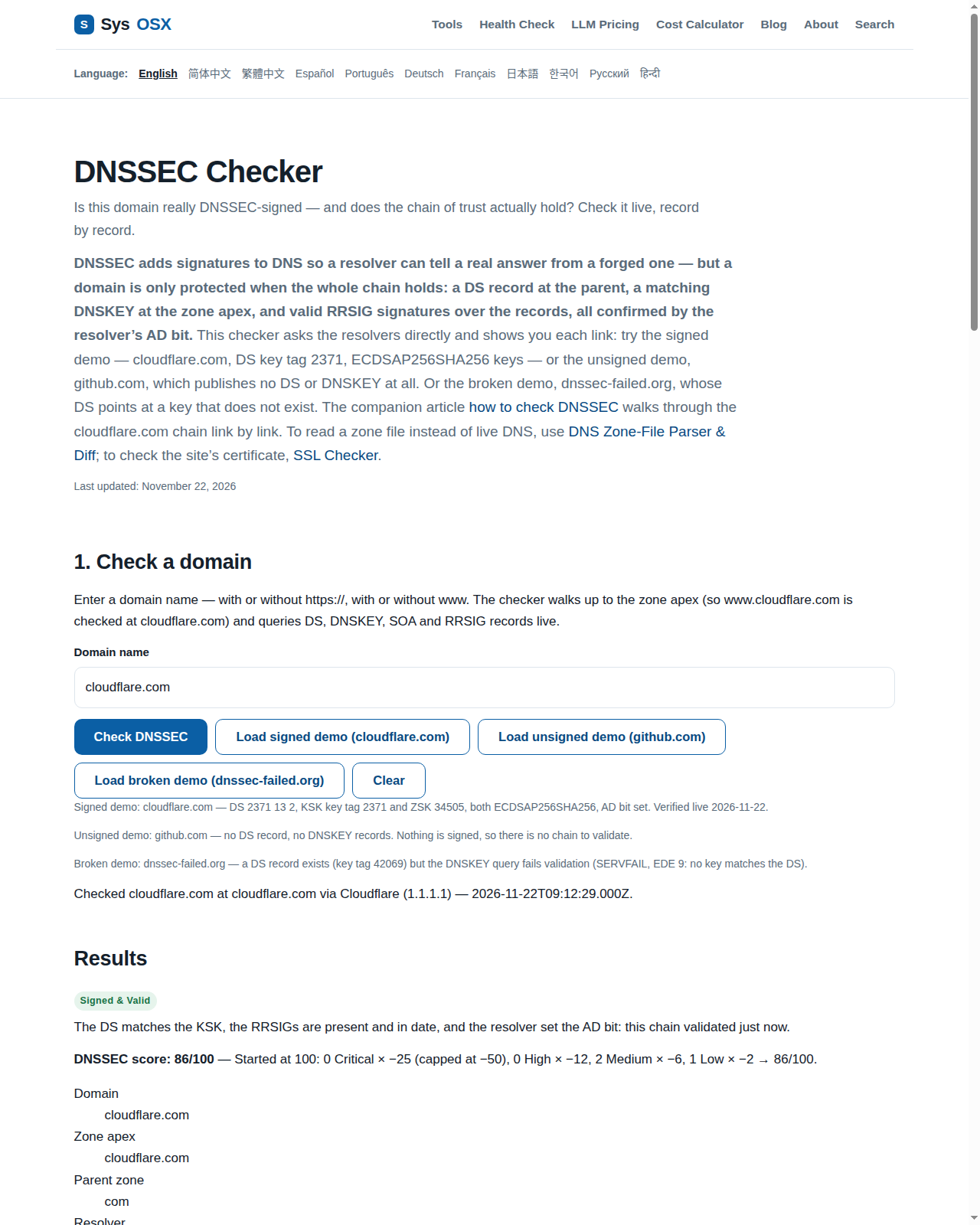
The signatures line up the same way. The RRSIG covering the DNSKEY record set is algorithm 13, signed by key tag 2371 — the KSK signing the ZSK, exactly as the design intends. The RRSIG covering the SOA record is algorithm 13, signed by key tag 34505 — the ZSK signing the zone data — with a validity window of about 50 hours. An NSEC record is also present at the apex, covering authenticated denial of existence. The same keys show up elsewhere: ietf.org is signed with the same KSK 2371 and ZSK 34505, because both domains share Cloudflare DNS infrastructure, though its DS digest is different (b1ae88aff068ddec3f7ff662f47d6599c74134425c67106e6c203942d6227ea4). When the DNSSEC Checker reports a domain as signed and valid, these are the pieces it has lined up: a DS in the parent, matching DNSKEYs in the child, RRSIGs from the right keys, and the AD bit set by the resolver.
Not signed versus broken — and what to do about each
The most common result is not an error at all: the domain is simply not signed. Take github.com, checked live on 2026-11-22. Its DNSKEY query returns Status 0 with AD false and zero answers; its DS query also returns Status 0 with AD false and no answers, with only an authority SOA from .com. There is nothing to fix and nothing to fear in the result itself — the domain works exactly like DNS has always worked, with no signatures to check and no protection if an answer is forged. The fix, if the owner wants it, is to enable signing, covered in the last section. One caution: do not pick your unsigned example by reputation. Example.com looks like the obvious unsigned demo, but it is in fact signed — github.com is the verified unsigned example here.
Broken is different, and worse: a DS exists, but the chain does not validate. The deliberate demo is dnssec-failed.org. Its DS record is present — key tag 42069, algorithm 13, digest type 2 — but its DNSKEY query returns Status 2, SERVFAIL, with AD false and an extended error, EDE(9), reading "DNSKEY Missing no SEP matching the DS". Google resolver agrees, reporting "DNSSEC validation failure" with EDE 9, "No DNSKEY matches DS RRs". The joke is in the data itself: the DS digest decodes to the ASCII text "broken chain of trust send help!". A validating resolver refuses to answer at all, so the domain is unreachable for users behind validating resolvers. The usual real-world causes are mundane: the DS at the registrar still points at an old KSK after a key rollover, signatures have expired because the zone was not re-signed, or a deprecated algorithm is in play. The remedy is on the owner side — publish the DS that matches the current KSK, re-sign the zone, or remove the stale DS entirely. Note the asymmetry: a broken DS is worse than no DS, because unsigned DNS still resolves while broken DNSSEC fails closed.
What the checker does — and what it does not do
The DNSSEC Checker queries live resolvers over DNS-over-HTTPS — Cloudflare at https://cloudflare-dns.com/dns-query and Google at https://dns.google/resolve — using the JSON format, with no API key and no cost. It asks for the DS, DNSKEY and RRSIG records and shows whether they line up: the DS key tag against the KSK, the RRSIG signer tags against the published keys, and the AD bit the resolver set. One detail matters if you repeat the query yourself: RRSIG records are only returned when the request asks for DNSSEC data, with do=1. Without it, the resolver strips the signatures and you see a plain, unsigned-looking answer. The tool also cross-checks the DS digest against the KSK and reports the algorithm numbers in plain language, so "13" reads as ECDSAP256SHA256 rather than a bare code.
The limits are part of the result, not fine print. The checker does not perform full independent chain validation from the root trust anchor inside the browser; it relies on the AD bit set by the resolver plus the visible consistency of DS, DNSKEY and RRSIG records. It does not verify Ed25519 (algorithm 15) signatures locally, because WebCrypto has no Ed25519 support. And it is not a replacement for a full validator: when you need a complete chain walk with every link explained, use Verisign DNSSEC Analyzer or DNSViz. Two readings that look alarming are normal: AD false on an unsigned answer is the expected state, not an error, and a SERVFAIL from a validating resolver is the system working as designed — it is refusing a bad answer rather than passing it on. If you want the zone-file side of the same story, the DNS Zone-File Parser reads and diffs the records themselves.
How to enable DNSSEC for your domain
Enabling DNSSEC is two steps, owned by two different parties, and the order matters. First, turn on signing at your DNS provider: they generate the KSK and ZSK, publish the DNSKEY records, and sign the zone. Second, copy the DS record to your registrar, which publishes it in the parent zone — this is the step people forget, and without it the chain has no link from the parent. Some registrar and provider combinations automate this with CDS and CDNSKEY records, where the provider publishes a copy of the DS and the registrar picks it up; if yours offers that, use it. Then verify with the checker: you want to see the DS, the matching DNSKEYs, RRSIGs from the right keys, and the AD bit set.
Three habits keep it working after that. Watch key rollovers: a ZSK rollover is your provider business, but a KSK rollover needs a new DS at the registrar, and a stale DS is the single most common way a working setup breaks. Watch signature expiry: RRSIGs carry validity windows, and a zone that stops being re-signed goes dark for validating resolvers when the signatures lapse. And re-check after any DNS provider migration, because the keys change with the provider and the DS has to follow. If anything goes wrong, remember the asymmetry from the previous section: removing a stale DS restores resolution immediately, while leaving it in place keeps the domain unreachable. Enable it, verify it, and check it again after every change.
Try it yourself: the real DoH answer for cloudflare.com
{"Status":0,"AD":true,"Question":[{"name":"cloudflare.com","type":43}],"Answer":[{"name":"cloudflare.com","type":43,"TTL":86400,"data":"2371 13 2 32996839a6d808afe3eb4a795a0e6a7a39a76fc52ff228b22b76f6d63826f2b9"}]}
// Matching DNSKEY (KSK, key tag 2371): 257 3 13 mdsswUyr3DPW132mOi8V9xESWE8jTo0dxCjjnopKl+GqJxpVXckHAeF+KkxLbxILfDLUT0rAK9iUzy1L53eKGQ==