DNS Delegation and Glue Records Explained: The Two NS Sets, the Chicken-and-Egg Fix and the Lame Server
Last updated:
DNS delegation is the handover of a domain from its parent zone to its own name servers: the parent publishes NS records naming the servers, and every resolver follows those records to reach the zone; glue records are the address records the parent adds when a server’s name lives inside the domain itself. Delegation looks like a single setting, but it is stored in two places — the parent zone, edited at your registrar, and the apex of your own zone — and the two copies drifting apart is one of the most common causes of “the site works for some people” DNS failures. This guide explains how delegation and glue work, what breaks when they disagree, and how to check yours with the DNS Delegation & Glue Checker.
What delegation is, in one breath
When a resolver needs www.example.com, it walks down from the root: the root refers it to .com, and .com refers it to example.com’s name servers. That second referral is the delegation — a set of NS records in the parent zone that says “these servers speak for this domain”. Nothing inside your zone is consulted until a resolver has followed the delegation to reach it, which makes the delegation the single most load-bearing part of your DNS: if it is wrong, the zone behind it might as well not exist.
The subtlety is that the NS set exists twice. The parent publishes it at the delegation point, and your zone publishes it again at its own apex. Protocol-wise the child’s copy is the authoritative one — but resolvers can only discover it through the parent’s copy, so in practice both must agree. They are edited in different places (registrar panel versus DNS provider), often by different people, at different times: every DNS migration that updates one and forgets the other leaves the two sets telling different stories to different resolvers.
Glue records and the chicken-and-egg problem
A referral is only useful if the resolver can reach the servers it names. When a name server’s name lives outside the delegated domain — ns1.dnsprovider.net serving example.com — the resolver simply looks that name up in its own zone. But when the name lives inside the domain being delegated — ns1.example.com serving example.com — the lookup is circular: to ask example.com’s servers anything, you first need their addresses, which live in example.com. Glue breaks the circle: the parent zone carries the A and AAAA records for in-bailiwick server names and hands them out in the referral’s additional section.
Glue is a copy of data that also lives in the child zone, and like every copy it can go stale. Renumber a server, migrate to new addresses, retire a name server — change the child zone and forget the glue at the registrar, and the parent keeps handing out the old addresses. The failure is partial and confusing: resolvers that try a glued address first may reach a dead or wrong server, retry, and sometimes succeed through another path, so the domain looks intermittently broken rather than down. The fix is always at the registrar, where glue (often called host records or child hosts) is registered per hostname. 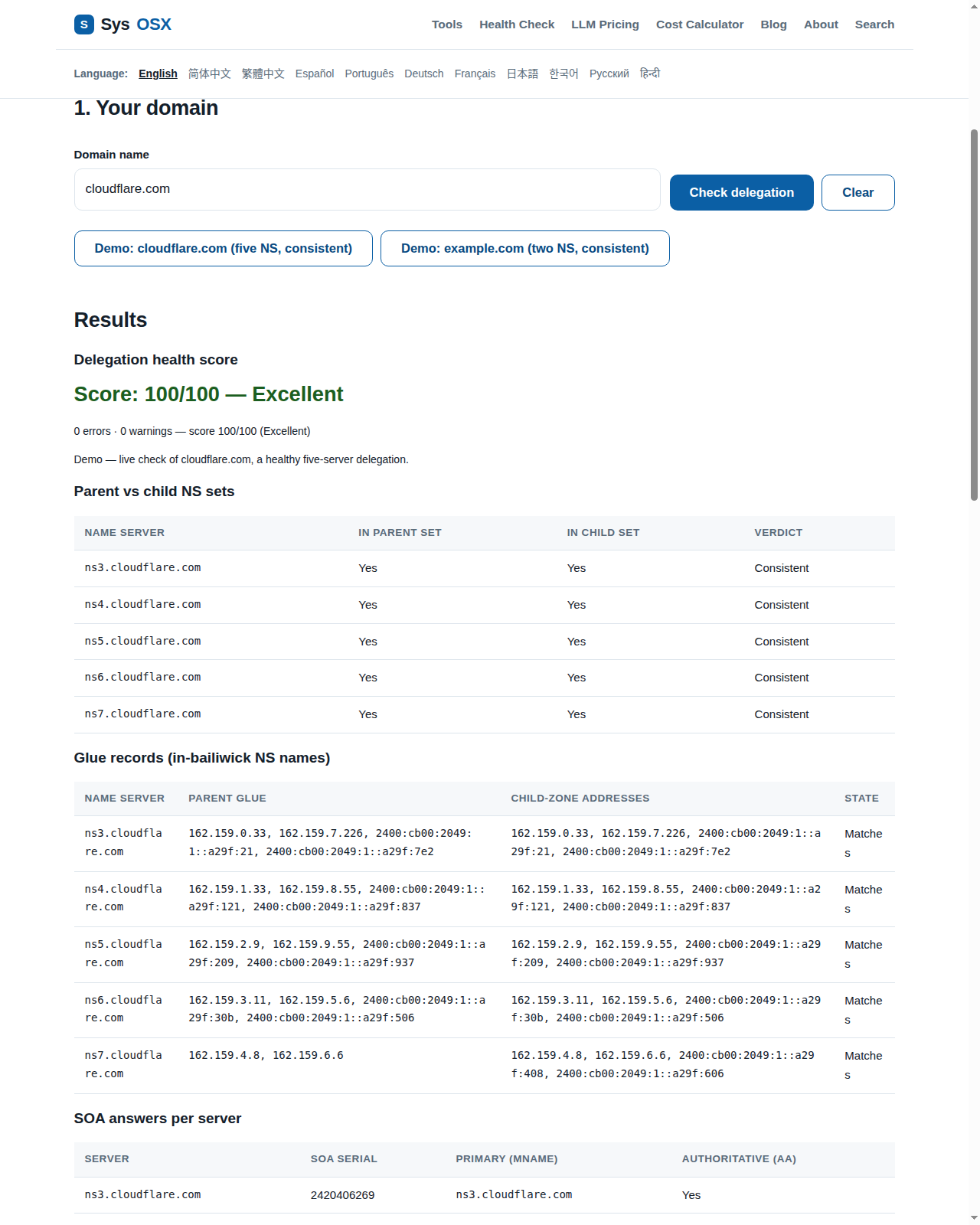
Lame delegation: the server that isn’t
A lame delegation is a delegation to a server that is not authoritative for the zone. The parent says “ask ns2.example.com”, a resolver asks it — and it answers without the AA (authoritative answer) flag, because it does not actually load the zone: it was never configured, the zone was removed, or the delegation outlived the hosting account. Some lame servers answer with a referral or another zone’s data; some refuse outright. Either way the resolver has burned a round trip on a dead end and must try another server, adding latency to every lookup and failing hard when the lame server is the only one a resolver reaches first — or the only one left.
Lameness is a mismatch between paperwork and reality, which is why it so often appears after migrations and provider changes: the delegation at the registrar is a claim, and the servers’ configuration is the fact. It also hides well — a domain with three good servers and one lame one resolves fine most of the time, because resolvers retry and cache the working paths. The symptom users report is not “down” but “flaky”: occasional slow loads, sporadic resolution errors, problems that vanish before anyone can reproduce them. Checking lameness means asking each delegated server directly and looking at the AA flag — exactly what the checker does.
Why the NS sets must match — and the serials must agree
With two copies of the NS set in circulation, a mismatch weaponises DNS caching against you. A resolver that learned the parent’s set may query a server the child has retired — which, if it still runs, happily serves its frozen copy of the zone with old addresses and old mail routing. A server added to the child but missing from the parent is invisible until resolvers happen to learn the child’s set. And because resolvers cache whichever set they last saw, the same user can flip between the two realities as caches expire — the classic “fixed for me, broken for my colleague” bug that survives days of debugging because everyone’s cache tells a different truth.
Inside the child zone, the equivalent agreement is the SOA serial: the zone’s version number, which secondary servers use to decide whether to transfer a fresh copy. When the authoritative servers answer with different serials, at least one of them is serving a different edition of the zone — a secondary whose transfer is stuck, or a server replicating from the wrong source. Serial divergence does not break resolution outright; it makes it inconsistent, with the stale server’s share of traffic seeing old records until the transfer is fixed or the zone expires on it.
The CNAME mistake and the other classics
The most quotable delegation rule is also the most broken: a name server’s name must never be a CNAME. RFC 1912 §2.4 and RFC 2181 §10.3 both forbid it — the target of an NS record must be a canonical hostname with its own address records, not an alias. Aliases add a lookup the delegation was designed to avoid, and resolvers handle them inconsistently: some follow the alias, some refuse, some cache the indirection and break when the alias changes. It typically appears when someone points NS names at a load balancer’s hostname or a provider’s vanity name that is itself an alias — convenient, and wrong.
The rest of the classic list is quieter. A delegation with a single name server has no one to fail over to — one reboot takes the domain off the internet for anyone without a warm cache. Name-server hostnames with no address records anywhere are unreachably delegated, the extreme form of a glue mistake. All name servers in the same /24 share one network’s fate — a heuristic worth flagging, though only an ASN-level view proves true independence. And an NS TTL measured in tens of seconds forces every resolver to re-walk the delegation constantly, trading a theoretical agility for real latency on every lookup.
Check yours in two minutes
The DNS Delegation & Glue Checker performs the comparisons in this guide from the outside, the way a resolver experiences them: it asks a parent-zone server for the referral and its glue, asks one of your own servers for the child NS set, and queries every delegated server for its SOA. Scoring starts at 100: errors cost 12 each (capped at −48) — an NS name on only one side, an NS name that is a CNAME, an NS hostname with no address, a lame server; warnings cost 5 (capped at −25) — stale glue, differing SOA serials, fewer than two name servers; info costs 1 (capped at −8) — all addresses in one /24, an NS TTL under 300 seconds.
Two honest limits. The answers are public DNS as seen from the checker’s network at that moment: caches and propagation mean a re-check minutes later can differ, especially right after a fix — wait out the parent TTL before declaring a change broken or fixed. And delegation health is one layer: the checker does not validate DNSSEC over the delegation (use the DNSSEC Checker for the DS/DNSKEY chain) and does not audit the records inside the zone (the DNS Lookup reads those). A domain can be perfectly delegated and still publish the wrong A record — but with a broken delegation, nothing else gets the chance to be right.
A correct delegation, on paper
; The parent zone (.com) delegates example.com:
example.com.        NS   ns1.example.com.
example.com.        NS   ns2.example.com.

; Glue in the parent — needed because both NS names are
; in-bailiwick (they live inside example.com itself):
ns1.example.com.    A    192.0.2.10
ns1.example.com.    AAAA 2001:db8::10
ns2.example.com.    A    192.0.2.11
ns2.example.com.    AAAA 2001:db8::11

; The child zone must publish the SAME NS set at its apex,
; and every server must serve the same SOA serial:
example.com.        NS   ns1.example.com.
example.com.        NS   ns2.example.com.
example.com.        SOA  ns1.example.com. hostmaster.example.com. 2026112801 7200 3600 1209600 3600
Sources
- RFC 1912 — Common DNS Operational and Configuration Errors (§2.4: NS names must not be aliases; the two NS sets must agree)
- RFC 2181 — Clarifications to the DNS Specification (§10.3: the target of an NS record must not be an alias)
- Verisign — DNS glue records: how parent-zone glue works and when it is required