Certificate Transparency Subdomains: Your Certificates Advertise Your Attack Surface
Last updated:
Certificate transparency is a public, append-only log of every TLS certificate issued by public certificate authorities — and because every certificate names the subdomains it covers, the log is also a public inventory of those subdomains. This is a feature, not a bug: the logs exist so that a certificate issued for your domain without your knowledge can be spotted by anyone. But the same openness means attackers, competitors and auditors can enumerate your subdomains from your certificate history alone — no scanning, no guessing, nothing that touches your network. This article explains what certificate transparency is, why every certificate advertises your subdomains to the world, how to use CT as a free attack-surface inventory (and how defenders monitor it to catch shadow IT and phishing infrastructure early), which names leak internal structure, where the limits are, and how to find your own subdomains in two minutes with the Subdomain Finder via Certificate Transparency.
What certificate transparency is, in one paragraph
Before certificate transparency, a certificate authority could issue a certificate for any domain — by mistake, by compromise, or by fraud — and nobody outside that CA would ever know. CT, standardised as RFC 9162, changed the deal: public CAs must submit every certificate they issue to public, append-only logs, browsers require proof that a certificate appears in those logs, and anyone can search them. The best-known search is crt.sh, run by Sectigo: ask it for a domain and it returns every logged certificate covering that domain or its subdomains, with the full name list of each certificate attached.
The security goal is detection. If a certificate for your domain appears that you did not request, you can see it — and so can researchers watching for phishing sites, which routinely need certificates for look-alike domains. Monitoring services and search engines continuously read the logs, which is why a brand-new subdomain with a fresh certificate tends to be discovered, scanned and catalogued within hours of its first certificate being issued, whether or not anyone ever linked to it.
Every certificate advertises its names — that is the design
A certificate has to name what it covers: the subject alternative names (SANs) list every hostname the certificate is valid for, and a single certificate often covers several subdomains at once. When that certificate is published to a CT log, those names are published with it — permanently, because the logs are append-only. Renewals add more entries. A wildcard certificate advertises less (just *.example.com), but the moment a concrete host gets its own certificate, its name joins the public record with a timestamp.
The practical consequence is one many teams learn late: a subdomain is not a secret, and never was. The staging server, the VPN gateway, the internal dashboard that 'nobody can find because we never linked to it' — if it has a public certificate, its name has been world-readable since the certificate was issued. Security through an unguessable hostname is not a control; CT made that true in public, for everyone, with receipts. The Certificate Transparency Search shows the underlying certificates themselves if you want to audit issuance rather than names.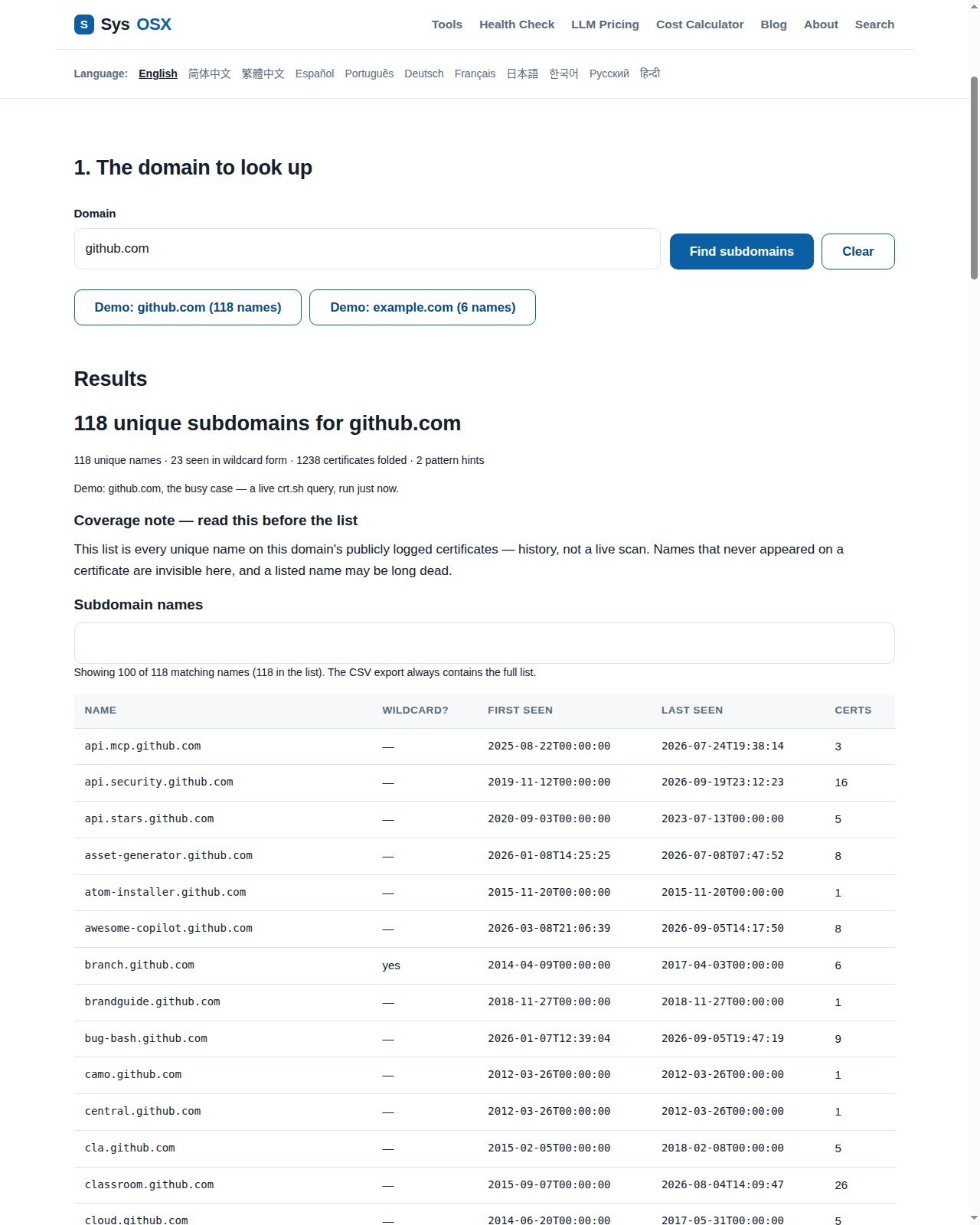
CT as a free attack-surface inventory — for both sides
For an attacker, a CT query is the quietest possible reconnaissance: it reads a third party's public log, generates no traffic to your network, triggers no alerts, and returns a decade of naming history in one response. Forgotten subdomains are the prize — the test instance from 2019 that still runs, the migration host that was never decommissioned — because forgotten systems are unpatched systems, and their names are sitting in the log. This is why subdomain enumeration via CT is step one of almost every external attack-surface assessment.
Defenders get the same feed, and the smart ones automate it. Watching the CT logs for your own domains catches shadow IT the day it gets a certificate — the marketing microsite, the vendor trial, the engineer's side project on the corporate domain — long before it shows up in an audit. Watching for look-alike domains catches phishing infrastructure at certificate time, often before the phishing page itself is live. The inventory view is what the Subdomain Finder builds: every certificate folded into one row per unique name, with first and last seen, so the shape of the estate is visible at a glance.
The names that leak internal structure
Some names say more than 'a host exists'. Labels like dev, staging, stg and test advertise your deployment pipeline and which environments face the internet. internal suggests a system that was never meant to be public. vpn names the remote-access edge; admin names the door to knock on. None of these is a vulnerability by itself — but each one tells an outsider how your organisation is built, which vendors you run, and where the interesting doors are, and it costs them one query to learn it.
That is why the finder flags exactly those labels as 'worth a look' — as name-pattern hints, clearly labelled, not as findings of fact. A flagged name may be a decommissioned test host from 2018; the log cannot tell you whether it is alive. But if a name like that still resolves and still answers, it deserves a hard look: staging systems routinely run with weaker authentication, older code and richer debug output than production, and they are reachable by anyone who can read a log — which is everyone.
The limits: history is not a live scan, and no cert means invisible
CT is a record of certificates, not of hosts. Three gaps follow. First, anything that never got a public certificate is invisible: hosts behind a wildcard only, services on private CAs, internal names on split-horizon DNS. An empty CT result proves nothing about what exists. Second, the log never forgets: a name certified in 2016 and decommissioned in 2017 is still listed, so the raw list overstates the live estate — treat first/last seen as a filter, and check DNS before treating any name as current. Names that no longer resolve anywhere useful are exactly what the Dangling DNS Checker follows up on.
Third, the data itself is a best effort. crt.sh is a free service indexing enormous logs; new certificates can take hours to become searchable, ingestion has gaps, and the service occasionally times out under load. Different CT searches can return slightly different sets. For an inventory that is 95% of the truth for free, that is a good trade — as long as nobody mistakes it for 100%. Authoritative internal truth still lives in your own CA records, DNS zones and cloud accounts; CT is the outside view, the one your attackers share.
Find yours in two minutes
Open the Subdomain Finder via Certificate Transparency and try the demos first: github.com folds 1238 logged certificates into 118 unique names — 23 of them seen in wildcard form, with dev.gtm.github.com and stg.github.com flagged as pattern hints — while example.com is the quiet case at 6 names from 81 certificates. (Both counts were verified against crt.sh when the tool was built; the logs only grow.) Then enter your own domain. Read the coverage note, filter the table, export the full list as CSV, and work through it with one question per name: do I know what this is, and should it still exist?
Two follow-ups turn the list into hygiene. For every name you do not recognise, check whether it still resolves and what it points at — an unrecognised name pointing at a third-party service nobody uses any more is a subdomain-takeover candidate, and the Dangling DNS Checker is built for that pass. And for every name you do recognise, ask whether it still needs a public certificate at all: names that must be public should be defended as public, and names that should not be public should stop being certified in public — because from the moment the certificate issues, the name belongs to everyone who can read a log.
Try it yourself: the raw crt.sh query
https://crt.sh/?q=%.example.com&output=json
# One query: every certificate crt.sh has logged for example.com
# and its subdomains, as JSON. Each result's name_value lists the
# names on that certificate, one per line — fold them together,
# strip the *. wildcard prefixes, drop names that do not end in
# the domain, and the unique-name list is what is left.