BIMI, MTA-STS and TLS-RPT Explained: The Logo, the Downgrade Shield and the Failure Reports
Last updated:
BIMI is a DNS record that lets supporting mailbox providers show a domain’s logo next to its authenticated mail; MTA-STS is a published policy that requires supporting senders to deliver to a domain over TLS with a valid certificate; TLS-RPT is a DNS record that tells senders where to report TLS delivery failures. The three records solve three different problems — a spoofed-looking inbox, a silent downgrade to cleartext, and failures nobody ever hears about — and they are all plain DNS, published in an afternoon. This article explains what each mechanism is, what a correct record set looks like, the five mistakes that break them, what they cannot do, and how to check your own domain in two minutes with the BIMI / MTA-STS / TLS-RPT Checker.
Three records, three different problems
Start with the problems, because the three mechanisms are constantly confused with each other and with SPF, DKIM and DMARC. Problem one: your mail looks like anyone’s mail. A phisher copies your name and layout, and in a crowded inbox nothing distinguishes the real message from the fake at a glance. BIMI is the answer: a TXT record at default._bimi.your-domain, starting v=BIMI1, pointing at your logo (l=, an SVG file over https) and at the evidence that the logo is yours (a=, a Verified Mark Certificate). Providers that support BIMI — Gmail, Yahoo, Apple Mail among them — show the logo next to authenticated mail, turning a trademark into an inbox signal.
Problem two: SMTP encryption is opportunistic. When one mail server delivers to another, it upgrades to TLS if STARTTLS is offered — but a network attacker in the middle can strip that offer, and the sender, never knowing TLS was possible, delivers in cleartext. MTA-STS (RFC 8461) is the domain’s published promise that TLS is mandatory: senders cache the policy and fail closed instead of downgrading. Problem three: when TLS delivery does fail — an expired certificate, a misconfigured MX — it fails silently. TLS-RPT (RFC 8460) closes that loop: a record at _smtp._tls.your-domain naming report addresses, and supporting senders post daily aggregate reports of every failure they saw.
What a correct record set looks like
A correct BIMI record is one line: v=BIMI1, an l= with the https URL of an SVG Tiny PS logo, and an a= with the URL of the Verified Mark Certificate. The record alone is not the whole story — BIMI builds on DMARC, and providers only display the logo for mail from a domain whose DMARC policy is at enforcement (p=quarantine or p=reject). A correct MTA-STS setup is two pieces that must agree: the TXT record at _mta-sts (v=STSv1 plus an id= that changes whenever the policy changes, so senders notice) and the policy file at https://mta-sts.your-domain/.well-known/mta-sts.txt, plain text lines declaring version: STSv1, a mode:, one mx: line per host pattern, and a max_age: in seconds.
A correct TLS-RPT record is also one line: v=TLSRPTv1 and a rua= list holding at least one mailto: or https: URI that actually reaches a mailbox or endpoint somebody reads. The code block below shows a complete, correct set for one domain — an enforcing policy whose mx: lines cover both MX hosts, a max_age of a week, a BIMI record with a VMC, and a reporting address. Compare it with the biggest domain on the internet: google.com publishes all three too, and its BIMI record has empty l= and a= values — a published record with no logo at all, which is valid, scores full marks for presence, and displays nothing. 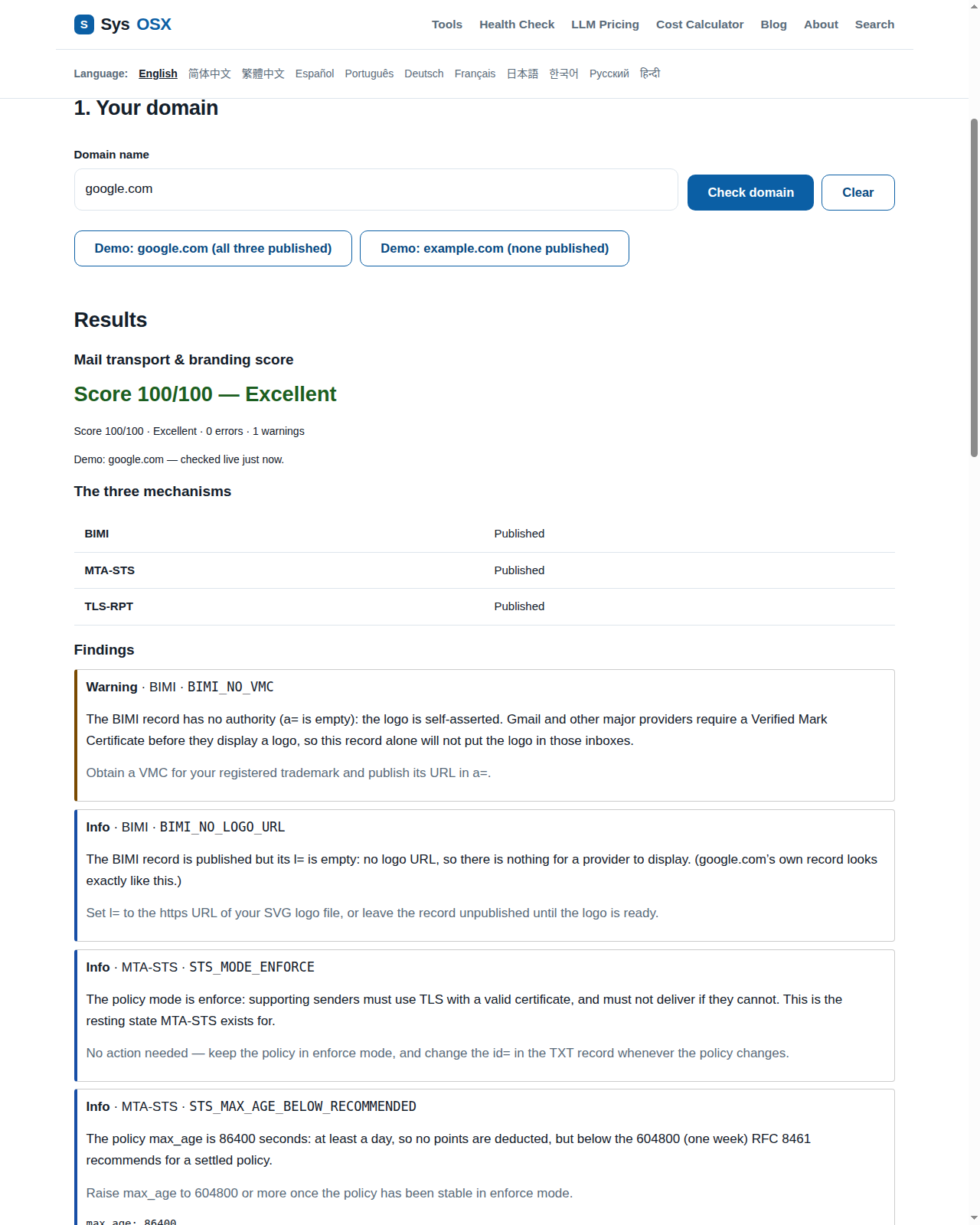
The five mistakes that break them
First, the missing id=. An MTA-STS TXT record without id= — or with an id= nobody changes when the policy changes — means senders keep applying the cached old policy; the id is the change signal, and forgetting it is the most common MTA-STS error. Second, testing mode forever. mode: testing is a rollout step: senders report failures but still deliver, so no downgrade is stopped. Domains park there for years and believe they have MTA-STS protection they do not have. Third, a max_age that is too small. The policy is fetched over the very connection it exists to protect, so a max_age of an hour re-opens the downgrade window every hour; RFC 8461 recommends at least 604800 — a week — for a settled policy, and anything under a day should be treated as a draft.
Fourth, self-asserted BIMI with Gmail expectations. Publishing v=BIMI1 with a logo and an empty a= is legitimate BIMI, but Gmail requires a Verified Mark Certificate — issued against a registered trademark — before it displays anything. The record is not broken; the expectation is. Fifth, the rua typo: a TLS-RPT record whose rua= is a bare address without mailto:, or a mailbox nobody reads, or a domain that does not exist. The record parses, the reports go nowhere, and the first TLS failure you hear about is the one a customer reports. Every one of these five is a one-line fix — but only if you look, which is what the reports and a checker are for.
What these records cannot do
They do not encrypt mail content end to end. MTA-STS protects one hop — a supporting sender delivering to your MX — with transport TLS. The message still sits readable on servers at both ends and on every hop in between that does not negotiate TLS; it is not S/MIME or PGP, and it was never meant to be. They do not stop phishing from lookalike domains, either: BIMI, MTA-STS and TLS-RPT all speak for your exact domain. An attacker who registers your-domain-secure.example can publish a perfect record set for it, logo included if they skip the VMC — what stops that mail is DMARC alignment, filtering and user judgement, not these three records.
And they only bind the senders that implement them. MTA-STS is honoured by the large senders — Gmail, Microsoft, Yahoo among them — which covers most real mail, but a sender with no RFC 8461 support delivers exactly as it did in 2010, downgrade risk included. TLS-RPT has the same shape: reports arrive from supporting senders only, so a quiet report stream means either no failures or no reporters, and the record cannot tell you which. Publish all three because the supporting senders are the ones that matter — but do not mistake a published policy for a universal one.
How the three fit with SPF, DKIM and DMARC
The email-authentication stack has two halves. SPF, DKIM and DMARC answer the question "is this message really from that domain, and what should happen if it is not?" — they are about identity, and the Email Deliverability Check covers them. BIMI, MTA-STS and TLS-RPT answer different questions: "what does the real sender’s mail look like" (BIMI), "must this delivery be encrypted" (MTA-STS) and "who hears when encryption fails" (TLS-RPT). The dependency runs one way: BIMI needs DMARC at enforcement before providers display the logo, so identity comes first; MTA-STS and TLS-RPT stand alone and can be published any time.
That dependency is why the sensible order is the one the checker’s advice follows: DMARC to enforcement if you have not already, TLS-RPT a few days before MTA-STS so the failure reports are flowing when the policy lands, MTA-STS in testing until the reports are clean, then enforce with a long max_age, and BIMI last — it is the visible reward on top of a stack that already authenticates and encrypts. None of the three is a substitute for the identity half, and the identity half gives you none of the transport guarantees. A domain with all six record sets is not invulnerable, but it has closed the cheap attacks: spoofing its exact domain, downgrading its inbound mail, and failing silently.
Check yours in two minutes
Open the BIMI / MTA-STS / TLS-RPT Checker and try the demos first: google.com, publishing all three mechanisms, shows what a clean run looks like — score, mechanism cards, findings and the records exactly as published — and example.com, publishing none of them, shows the deductions. Then enter your own domain. The checker resolves the three TXT records and your MX hosts from its server, fetches the policy file and the BIMI logo, and your browser validates and scores the raw records: syntax, policy mode, MX coverage against the policy’s mx: patterns, max_age, and the rua addresses.
Read the score as a map, not a verdict. It starts at 100: no MTA-STS record costs 25; a policy that cannot be fetched or parsed costs 20; testing mode costs 8 and none costs 12; each MX host covered by no policy pattern costs 5, up to 10; a max_age under a day costs 5; a missing TLS-RPT record or an invalid rua costs 10; a missing BIMI record costs 5, a malformed one 8, and logo problems 5. Ninety or above is Excellent, 70–89 Good, 50–69 Needs work, below 50 Poor. Fix in deduction order — the MTA-STS record and policy first, because transport security is the substance; the logo last, because it is the paint.
A correct record set
; BIMI — the logo in the inbox
default._bimi.example.com.  TXT  "v=BIMI1; l=https://example.com/logo.svg; a=https://example.com/vmc.pem"

; MTA-STS — the pointer record (change id= whenever the policy changes)
_mta-sts.example.com.       TXT  "v=STSv1; id=20261128T000000;"

; The MTA-STS policy file, served at
; https://mta-sts.example.com/.well-known/mta-sts.txt
version: STSv1
mode: enforce
mx: mx.example.com
mx: mx2.example.com
max_age: 604800

; TLS-RPT — where the failure reports go
_smtp._tls.example.com.     TXT  "v=TLSRPTv1; rua=mailto:[email protected]"